Lasem, the 'Little China' on Java's Coast
From the 15th century, Lasem was one of the earliest landing points for Chinese settlers on Java, where Javanese, Chinese, Champa, Arab, and Dutch cultures mixed.
- Period
- 15th century
- Era
- Abad ke-15
- Places
- Lasem · Karangturi · Soditan · Babagan · Gedongmulyo · Sumbergirang
Lasem is a district at the eastern edge of Rembang Regency, yet its name is far larger than its area. For centuries this place has been one of the earliest landing points for Chinese settlers on Java. That is why it earned the nickname “Little China”, or in foreign accounts Petit Chinois, a term said by record to have been given by a French visitor.
One of the earliest landings
Facing the Java Sea directly, Lasem was a harbour easy to reach. Waves of arrivals from many directions met here: Chinese traders, parties from Champa, Arab merchants, and later the Dutch. From that meeting grew a society that had long been mixed, well before “acculturation” became a word people used.
The voyages of Admiral Zheng He (Cheng Ho) between 1405 and 1433 are also linked to Lasem. By local account, one of his expeditions brought a Champa princess named Na Li Ni, who settled and left a mark on the region’s batik tradition. This should be noted as a living legend, not an event neatly recorded in archives.
The Yellow War
Lasem also holds a story of resistance. The event known as Perang Kuning, the Yellow War, was a joint Chinese and Javanese stand against the VOC. One of its leaders, Raden Panji Margono, is remembered on the Javanese side, and his grave lies in Lasem. The war shows that ties between the two communities were not only commercial, but sometimes an alliance against a foreign power.
Heritage kampongs and temples
Traces of Lasem’s Chinese community still show in the names of its kampongs: Karangturi, Soditan, Babagan, Gedongmulyo, and Sumbergirang. Old temples stand there and remain in use, among them Cu An Kiong, thought to date from the 16th century and dedicated to Mazu, the goddess who protects sailors. Gie Yong Bio and Po An Bio stand nearby.
In Lasem, temples and old homes stand side by side, their architecture blended: Javanese roofs, Chinese doors, European carving.
A distinctive colour
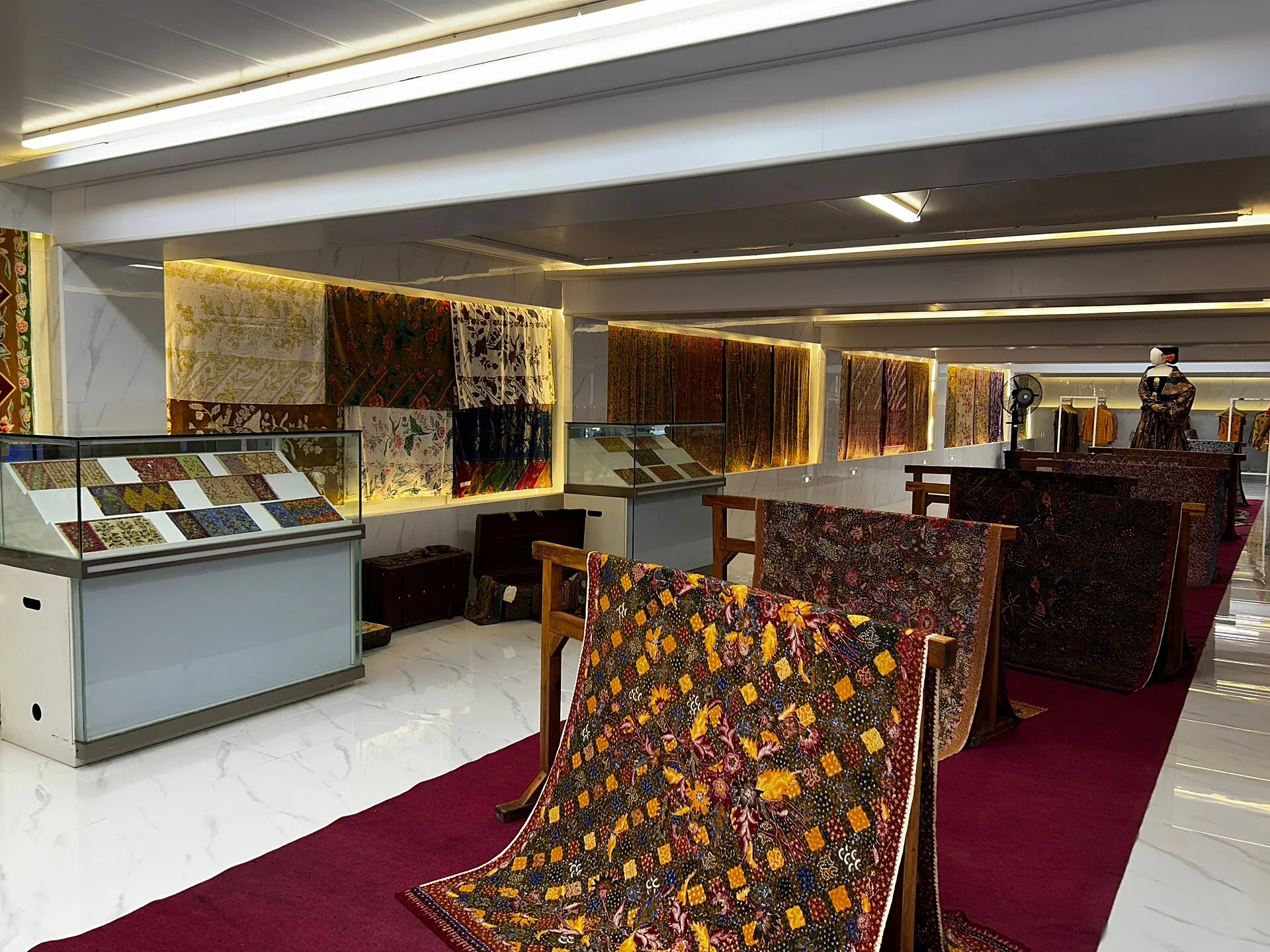
Lasem batik is known for its bold red, called locally abang getih pitik, red like chicken’s blood. Its motifs are mixed too: Chinese influences such as the phoenix and dragon, Javanese ones such as parang and kawung, and touches from coastal tradition. That blend makes Lasem batik hard to mistake for any other. Many artisans still work by hand, though pressure from the modern textile industry keeps growing.
Lasem batik and its recognition
Lasem is best known for its batik, whose colours are distinctive and shaped by Chinese tradition. In 2009, UNESCO named Indonesian batik an Intangible Cultural Heritage. Then in 2024, the Lasem batik trade archives were named a “Memory of the Collective Nation” by the National Archives of Indonesia (ANRI). Both honours confirm that Lasem is not merely an old story, but a heritage still tended today.