Lontong Tuyuhan
Triangular rice cake in a rich yellow coconut-milk broth, served with free-range chicken, tempeh, and offal, topped with fried shallots.
- Origin
- Tuyuhan Village, Pancur District
- Category
- Dish
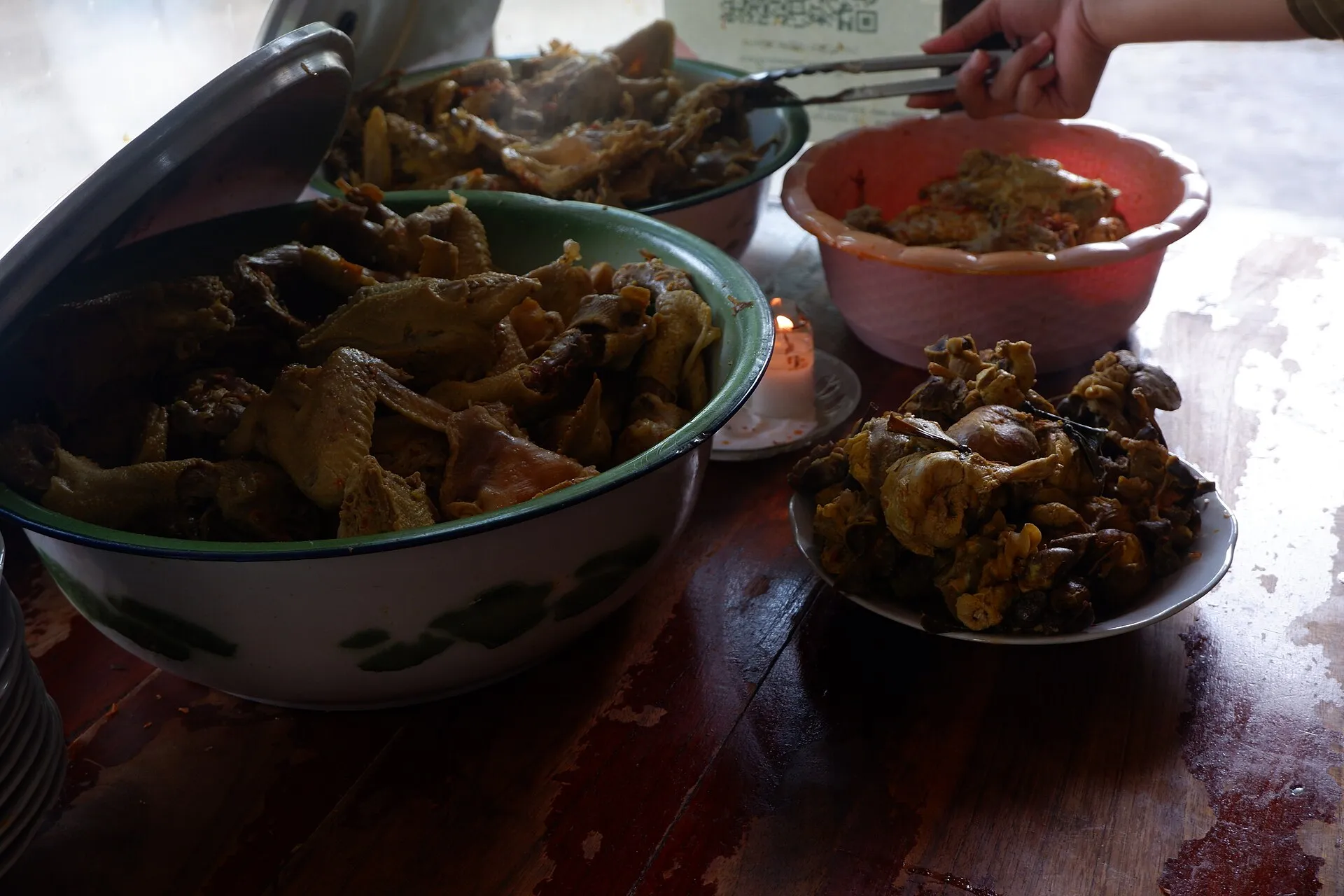
Lontong tuyuhan is one of Rembang’s most recognisable dishes, and not only for its taste. Where lontong is normally a cylinder, the lontong from Tuyuhan village is cut into a triangle, and that shape carries meaning of its own.
The triangle and what it means
By the story told in Tuyuhan, the triangular form was chosen to stand for three loves: love of God, love of fellow human beings, and love of nature. That idea has long been attached to the dish and shapes how local people understand their own food.
A rich yellow broth
What makes lontong tuyuhan special is the broth. The rice cake is served in a thick, deeply aromatic yellow coconut-milk broth, cooked with free-range chicken (ayam kampung), tempeh, and offal. The spice list is long: shallot, garlic, chilli, candied nut (kemiri), coriander, cumin, turmeric, galangal (lengkuas), aromatic ginger (kencur), lemongrass, and bay leaf. Together they give the broth its deep yellow colour and savoury depth.
Free-range chicken brings a firmer, more fragrant meat, while the tempeh soaks up the broth and turns soft. Offal adds another layer for those who enjoy it. The broth is simmered slowly so the spices infuse and the coconut milk does not split, keeping it smooth on the spoon. As a final touch, the dish is scattered with crisp fried shallots.
How it is eaten
Lontong tuyuhan is usually eaten hot, straight from the bowl. No rice is needed because the lontong already supplies the carbohydrate. It is best while the broth is still steaming, since coconut milk thickens and separates once it sits too long.
Because the broth is built on coconut milk, lontong tuyuhan is best sought from morning to midday, before the broth loses its freshness.
From Tuyuhan village
As the name suggests, the dish comes from Tuyuhan village, Pancur district. Local families serve it at celebrations, communal meals, and for honoured guests. In the village, lontong tuyuhan is not only a trade but part of how people welcome visitors and mark time together. Today stalls along the road to the village sell it daily, and many travellers make a point of stopping for it, especially at weekends when the route into Tuyuhan grows busy.